


Rick Shaffer and Pam LeBlanc pose next to a manhole cover proclaiming Wallace, Idaho, the “Center of the Universe.” Chris LeBlanc photo
Rick Shaffer, the unofficial prime minister of Wallace, Idaho, looks both ways before dashing into an intersection to pose next to a manhole cover proclaiming the historic mining town “The Center of the Universe.”
Shaffer, who’s wearing a black suit and bow tie with a pair of white sneakers, tells me that a group of people gathered in a nearby bar 20 years ago came up with the designation. The name stuck, and officials ordered a manhole cover that announced the city’s status to the world.
“You can’t prove it’s not, right?” Shaffer says.
Today, tourists seek out the intersection to photograph the manhole cover as proof. And every September, the city celebrates with a reading of the official Center of the Universe proclamation, music and beer.
The quirky town of Wallace is just one reason to visit Idaho’s panhandle. I’ve come for five days of bicycling, hiking and exploring the Silver Valley, a region that until now I’ve only visited in winter.
Read more: An Intro to Backcountry Skiing in Idaho
Ride the Route of the Hiawatha

Cyclists make their way along the Route of the Hiawathas in the Idaho panhandle. Pam LeBlanc photo
I scheduled my visit for late September, and number one on my to-do list was biking the Route of the Hiawatha, a multi-use trail built along an old railroad bed. The 15-mile pathway, which has a gentle downhill grade, passes through 10 tunnels and crosses seven trestle bridges.
We headed to Lookout Pass Ski and Recreation Area to rent bikes for the day and pick up trail passes. The ticket includes a shuttle ride from the bottom of the trail back to the top. (Or you can skip the shuttle and pedal back, if you prefer.)
The Milwaukee Railroad once ran on tracks along this passage, but in 1998 the route opened as a Rails to Trails project. An average of about 1,200 people a day during the four-month summer and fall season now bike the trail, which cuts through forests and valleys in the Bitterroot Range.
Read more: Palisade Wants You to Know There’s More to Colorado than the Front Range
The ride starts in East Portal, Montana, with a bang.
You’ll need to flip on your headlight (included with rental bikes) before you roll into the 1.66-mile St. Paul Pass Tunnel a few hundred yards from the trailhead.
Even if it’s warm outside, brace for change inside the tunnel, where temperatures hover around 47 degrees year-round. We wore rain jackets to protect us from the water dripping from the ceiling, but I still emerged (on the Idaho side of the border) with a muddy stripe up my backside.
The highlight? Taking in views of pine-covered mountains while spinning over steel trestle bridges. We stuffed sandwiches in our backpacks and pulled off the trail for a picnic by a creek. A deer moseyed over to say hello, then took a drink from the stream.
Interpretive signs along the route offer a glimpse into the area’s history, explaining how the bridges were built, who worked in the area mines, and the impact of fires and avalanches. There are vault toilets, too.
At the bottom, we waited 45 minutes for a shuttle to take us back to the top. It’s first come, first served. A snack bar there sells hot dogs, soda and sweets.
Cruise the Trail of the Coeur d’Alenes
We hopped on e-bikes for our second biking adventure, but like the Route of the Hiawatha, the bike trail follows the path of an old railway line, so it’s pancake flat.
The paved Trail of the Coeur d’Alenes runs for 73 miles across the Idaho Panhandle, from Mullan to Plummer. You can access it from any of 20 trailheads.
We started in Kellogg, where we rented bikes at Silver Mountain Resort, then rode 45 miles, including a detour to Catalpa Mission, the oldest standing structure in Idaho. We wrapped up with a beer at the Cycle Haus.
The highlight? Spotting a mountain lion trotting across the trail about 3 miles east of Harrison. The sleek feline, with a long tail and a graceful stride, didn’t dally. It just ducked into the woods about 30 yards in front of us, leaving us open-mouthed with amazement.
You’ll find plenty of picnic tables along the trail, which passes lakes, rivers, old mining towns, forests of tall trees and marshes where moose hang out.
The trail was part of an environmental cleanup effort. After the railbed was contaminated with heavy metals from mine tailings, Union Pacific Railroad, the federal government, the state of Idaho and the Coeur d’Alene Tribe installed a layer of asphalt and gravel to form a protective barrier.
Hike the Pulaski Tunnel Trail
A few years ago, I read Timothy Egan’s book “The Big Burn: Teddy Roosevelt and the Fire That Saved America.” The book details the wildfires of 1910 that destroyed more than 3 million acres in Idaho, Washington and Montana. At least 85 people died.
The book recounts the story of Ranger “Big Ed” Pulaski, who was working the blaze outside of Wallace with 45 men when hurricane force winds whipped the fire out of control. Pulaski led his crew into a mine shaft along Placer Creek, then ordered the men to lie face first on its muddy floor. As the story goes, Pulaski hung wet blankets over the opening and threatened to shoot anyone who tried to leave. All but five survived, including Pulaski, who suffered permanent damage to his lungs and eyesight.
A trail that follows part of Pulaski’s route starts about a mile from downtown Wallace on Forest Service Road 456. It’s a steep, 2-mile walk up Placer Creek up to the tunnel opening, barely visible from an overlook across a gully. Besides the history, it’s a beautiful walk, thick with firs, cedars and pines, and lush ferns.
Explore Settlers Grove of Ancient Cedars
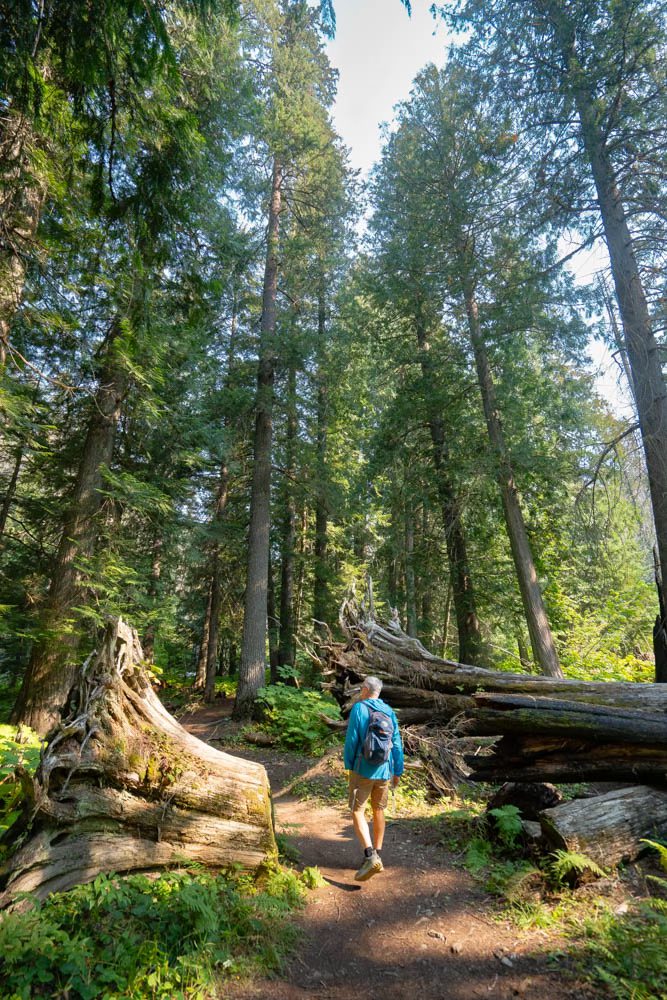
A hiking trail at the Grove of the Ancient Cedars winds through a forest of trees hundreds of years old. Pam LeBlanc photo
Hiking through Settlers Grove of Ancient Cedars feels like walking among a crowd of very tall – and very ancient – friends.
I spent a morning wandering at their ankles, staring up at rustling branches 150 feet overhead. It made me feel insignificant.
These trees were saplings long before America fought for independence. Some are 600 years old, and so big six men linked arm to arm couldn’t circle their trunk. Somehow, they survived the Big Burn of 1910. Another fire in 2015 burned through the area, but most of the biggies survived.
A 3-mile round-trip hike takes you among the old giants and along Eagle Creek. Some of the boards on the wooden bridges over the stream are starting to rot, so tread carefully.
The grove is located near the small town of Murray, Idaho. You’ll find a restroom at the trailhead and benches along the path.
Kick back in Kellogg
When you stay at the Silver Mountain Resort in Kellogg, you get free passes to the indoor waterpark. While it’s probably not a destination in itself, we spent an hour playing on the twisty tube slides and floating around the lazy river, which felt great after logging so many trail miles.
If You Go

Getting there:
Fly into Spokane, Washington and rent a car for the hour and a half drive to the Silver Valley. Wallace is about 50 miles east of Coeur d’Alene, Idaho.

Stay:
We stayed two nights at the Wallace Inn in Wallace, Idaho, and two nights at Silver Mountain Resort in Kellogg.

Do:
Bike the Trail of the Coeur d’Alenes, open daily year-round, or Route of the Hiawatha, open from mid-May to late September. Route of the Hiawatha passes cost $36 for adults ($18 without the shuttle) or $28 for ages 5-12 ($14 without the shuttle). Bring your own bike or rent one from Lookout Pass for $43 adults or $33 children. For more information go to http://www.ridethehiawatha.com/. Hike the Settlers Grove of Ancient Cedars and the Pulaski Tunnel Trail. See the Center of the Universe.

Eat & Drink:
Stop for craft beer and a menu that ranges from locally made sausage to burgers, street tacos and a Pam LeBlanc-approved Korean rice bowl with marinated skirt steak at Radio Brewing in Kellogg. Don’t miss the huckleberry milkshake at Blackboard Marketplace in Wallace, which also serves upscale Italian food for lunch and dinner. In Harrison, stop for ice cream at the Harrison Creamery and post-bike ride beers at the Cycle Haus,

If you go:
Register for a full moon night ride on the Route of the Hiawatha next summer. The rides take place one night each June, July, August and September.