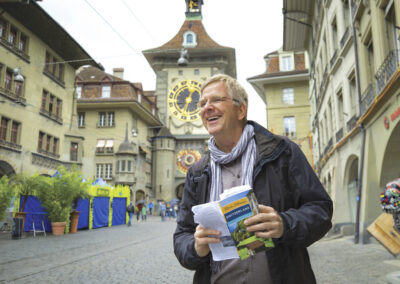


For more than four decades, Rick Steves has been traversing Europe with a singular focus: to take in everything he possibly can — the good, the bad, and the ugly — and use those experiences to inspire others to travel.
A popular public television host, best-selling guidebook author and renowned speaker, Steves spends 100 days in Europe each year with the hope that his journeys will result in smoother, smarter, and more impactful trips for his fans and followers.
“It’s so exciting to learn more about your home sometimes by leaving it and looking at it from a distance,” Steves told Austin Travels recently during Zoom interview.
We caught up with Steves, who had just returned to his home in Seattle from Italy, in advance of his upcoming “An Evening with Rick Steves” at the Paramount Theatre at 7 p.m. April 1. The following are excerpts from that interview.

Rick Steves takes a break from filming in Italy’s Dolomites. Contributed by Rick Steves
You’re coming to Austin this week for “An Evening with Rick Steves” at The Paramount Theatre. What can people expect?
What I like to do is bring the lessons I’ve learned from spending a quarter of my adult life living out of a 9-by-22-by-14-inch carry-on. I’ve only got one evening in Austin, so I’ll distill the most important lessons I’ve learned from my travels with beautiful photographs and lots of vivid stories and anecdotes so people can be inspired to travel in a way that they enjoy maximum travel thrills for every mile, minute and dollar of their experience. We Americans have the shortest vacations in the rich world, and we want to use our time smartly as well as our dollars. That’s the foundation of what I teach.
Why is it so important to you that people explore beyond the borders of the United States?
For me, there’s nothing wrong with Orlando, go there three or four times, then you can go to Vegas, and then you can go to Disneyland, and then take a Caribbean cruise, then you can go back to Orlando. But sooner or later, try something a little more challenging. You don’t need to just spend the rest of your life with a bunch of Americans in Cancun.
What do you say to someone who is apprehensive about international travel?
Go to a country that speaks a different language and get out of your comfort zone. Don’t try to avoid culture shock. Culture shock is a constructive thing, it’s the growing pains of a broadening perspective. It just needs to be curated, and that’s what a good guidebook does, or a good tour guide, and that’s what we do — we curate people’s culture shock so they can broaden their perspective and have a transformational travel experience.
RELATED: Big Apple dreams: A mom-daughter trip to New York City
Why have you decided to focus primarily on European travel?
The wading pool for world exploration is Europe. When I go to Europe, I’ve always got my little moleskin notebook, and it is filled with all sorts of lessons I’ve learned from my experience. When I make a mistake, I take careful notes. When I get ripped off, I celebrate — they don’t know who they just ripped off. I’m going to learn that scam and pack it into my talks. When I have a “eureka moment” that really is one of those gems that illustrates how great travel is I write it up so people can have a better, more impactful trip. I hit and I miss and I miss and I hit and bring home the hits so people can have a better batting average.
How has your life as a travel expert changed over the past four decades?
I’m doing exactly the same thing now that I was doing as a kid, when it was just me and some books in the back of the car to sell. But now I’ve got a staff of 100 people and I’ve got technology beyond my wildest dreams to amplify my teaching. I find that my passion for teaching has been like Maslow’s Hierarchy of Travel Needs.
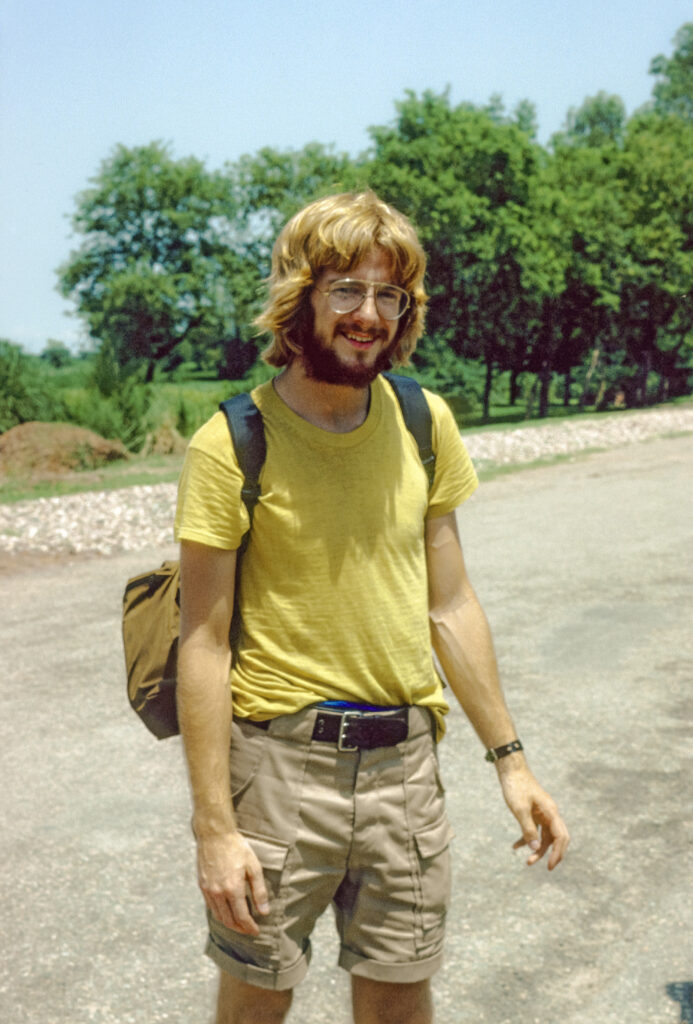
Rick Steves in Asia in 1978. Contributed by Rick Steves
In the beginning, it was just the bottom rung — how to catch the train, how to stay healthy, how to pack light, how to find a good dinner. The next era of my teaching was appreciating history and art and culture. I really was into that and I still love that. I just finished a six-hour series on the story of European art for public television, “Rick Steves’ The Art of Europe,” which is my favorite thing I’ve ever produced for television. I think that’s best six hours you can spend before your trip.
What is your main focus as a teacher these days?
Since 9-11, I’ve realized the pinnacle of that Maslow’s Hierarchy of Travel Needs is traveling in a way that broadens your perspective and that gives you the greatest souvenir, which is an understanding that the world is filled with beautiful people, it’s filled with love, it’s filled with joy. I’m not naive — there’s certain serious problems and bad characters out there — but the most powerful thing we can do as individuals is get out there and help our country fit better into this complicated planet. I’m so inspired by that right now, so any chance I get to go on the road and share the values of travel, that’s my passion as a teacher.
How are travel and politics related to each other?
I believe if everybody had to travel before they would vote we would not be in this pickle we’re in right now. We vote out of fear if we are not travelers. Who are the most frightened people on this planet? The people without passports. People buried deep in the middle of this great and powerful nation of ours whose worldview is shaped by fear mongering commercial TV news. If people could just get out there and get to know their neighbors, the world could be a much better place. There’s a lot of wisdom in those ideas — love your neighbor, get to know your enemy — this kind of thing. And when you travel, you realize that.
How do you describe your role in the world of travel?
In a way, I’m a little bit evangelical about the value of travel, and I’m also kind of like the medieval jester. A long time ago, in medieval Europe, the king would give the jester room and board just to be annoying. He would go outside the castle and hang out with the peasants in the ravine and in the barrio and then he would come back to the safety of the castle and he would tell the king what they’re thinking out there, what’s going on. The king needed that. As travelers, we can go out and come home and share with our neighbors how the United States can be part of the family of nations and what a beautiful and powerful thing that would be if we really want to have a country that we’re proud of.
You also give back to a lot of nonprofits. Why is that so important to you?
That’s what I call enlightened consumption. You reach a point where consuming more does not make you happier. Helping others people makes you happier. It fits my Christian faith, and it’s also just an enlightened way to be wealthy. I work hard, I produce a lot, I help make a lot of happy travels, and my joy is to take what I earn from that and help people in my community and help people south of the border who may never see their name on a plane ticket.
RELATED: Rest and rejuvenation in Mexico
What sort of experiences have you had outside of Europe?
I talk mostly about my experience in Europe and fundamentals of what is good travel, but at the same time I’m sharing how the most powerful moments and beautiful memories of my travels have often been in places that I’ve gone to where I’m not supposed to go. Nicaragua, Cuba, Palestine, Iran. These are all in the news these days, and if you’ve traveled there, you have a different angle on that than someone who let somebody else shape their worldview. It’s a beautiful thing.
Why is it so important for Americans to travel now?
We’re 4 percent of this planet. There’s 96 percent of it out there. I firmly believe travel can be a huge force for peace and stability on this planet, and it also just carbonates our existence to know what’s out there beyond our borders.