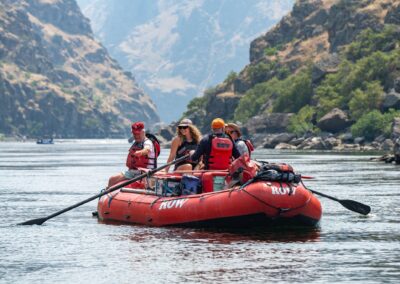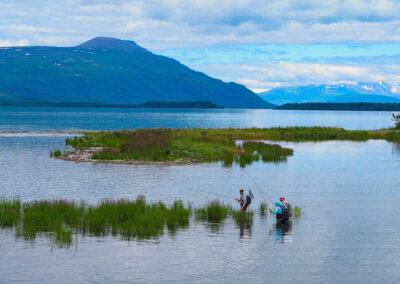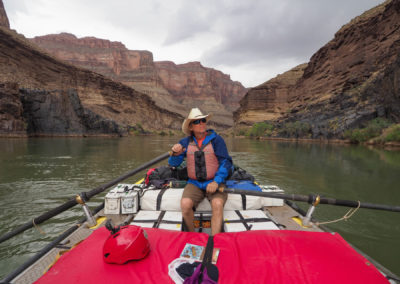



A raft makes its way down the Nahanni River during a week-long trip in the Northwest Territories of Canada. Pam LeBlanc photo
George’s Riffle doesn’t look all that intimidating at first, just a little white froth and about as much churning water as you’d see in a freshly flushed commode.
But the closer I get, the bigger it grows. By the time I paddle past a rotating whirlpool the size of a Volkswagen bug, the Class 3 rapid on the Nahanni River has my full attention.
I lurch forward, then backward, then shriek as an invisible force flings an ice-cold bucket of water over my rain suit. I feel like I’m trying to log 8 seconds on a bucking bull as I blast along an undulating train of waves.
Two minutes later, the water smooths out. I’m still upright in my inflatable kayak, and I’m pointed toward First Canyon, the deepest canyon on this river in the Northwest Territories of Canada.
I can’t stop smiling.
So far, I’ve faced logistical challenges, clouds of mosquitoes and an 8-hour drive on a dusty strip of gravel known as the Mackenzie Highway to get here. Despite the hiccups, this visit to the Nahanni National Park Reserve, a UNESCO World Heritage site and homeland of the Dene people, is turning into a rollicking adventure.
Read more: In Nebraska, sandhill crane migration draws flocks of birdwatchers
Getting to the Nahanni River

Water swirls around Mason’s Rock at Virginia Falls on the Nahanni River. Pam LeBlanc photo
Wildfires complicated our plans to get on the river with Nahanni River Adventures, which offers canoe and rafting trips in the sparsely populated Northwest Territories. My husband Chris and I have chosen the easier option – rafting.
In all, we’ll cover about 150 miles between Virginia Falls and Nahanni Butte. In that stretch, the river drops about 1,300 feet, passes through a series of canyons, then splits into a network of braided channels. Chances are good you’ll see moose, grizzly bears and bison.
Typically, customers fly into Fort Simpson. From there, they catch a floatplane to Virginia Falls, where they get on the river. But because the airport there was closed due to smoke, we drive eight hot, dusty hours on the rugged Mackenzie Highway, camp overnight at Blackstone Territorial Park, and aim for Virginia Falls, accessible only by floatplane or boat, the next day.
That flight, with just me, Chris and the pilot, sets the mood. Chris sits up front and I huddle next to a stack of bulging gear bags, wondering if our mosquito-like craft has enough oomph to get over the mountains. Turns out it does, and when we slide to a stop at the dock in front of the Virginia Falls campground, I feel like I’ve landed in a dream.
A series of boardwalks winds through the primitive campground, leading to wooden platforms where you can pitch a tent. Other walkways take you to overlooks of Virginia Falls (Náįlįcho), where water swirls around a huge outcrop called Mason’s Rock before crashing 300 feet to the river below. It’s spectacular.
We set up camp, tug on eye covers and fall asleep in the hazy, never-ending light of the far north.
Read more: Mountains, glaciers and more on a Smithsonian Journeys trip to Patagonia
Finally on the water
In the morning, we stuff our tent, sleeping bags and clothing into dry bags the size of small bears. Then we heave the bags over our shoulders and lumber down a long boardwalk that morphs into a twisty single-track trail on its way to the base of the falls.
We drop our load at the end of the mile-long portage (or “pork-tage,” as we dubbed it, since we’ve brought so much stuff), and walk along the riverbank to stand in the soaking mist.
A few hours later, our group of a dozen passengers and three guides clambers into three yellow rafts. We don’t get far before the rain starts – fat, friendly drops that you crave when you live in a drought-prone place like Texas. The shower doesn’t last long, but it does wash the smoke out the air.
Our trip down a ribbon of green-gray water has officially begun.
That night, we settle onto a sand and gravel beach bordered by a forest of black spruce, white birch and Jack pine. Almost immediately, we slap our ankles. Ants have invaded.
We move, then move again. They’re everywhere, trying to dampen our high spirits. Then we make a discovery: If we don’t move our feet, they won’t bite.
We reach ant détente.
Passing through the Gate

Chris LeBlanc paddles an inflatable kayak during a trip with Nahanni River Adventures. Pam LeBlanc photo
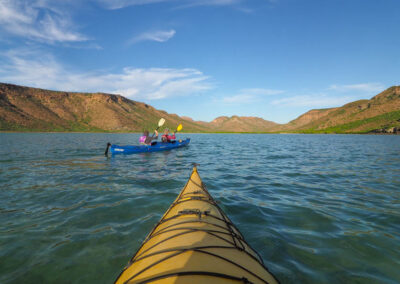
Riding in an inflatable kayak is like sitting on a blow-up pool toy as it bobs on the water. It bounces through easy rapids and gives you the freedom to blaze your own path.
I hoist myself into the bright blue vessel and point downstream, pulling myself into the current.
By lunchtime, we’ve reached The Gate, where the river squeezes through a gorge lined by 1,500-foot cliffs. We pull over to explore.
From an overlook near the top of the ridge, we peer down on the watery highway. After a break for lunch, we re-launch our flotilla. The winds pick up. This time I’m in the raft, wedged into a cushioned space at the front of the boat. We sail downstream on the breeze, admiring a huge pillar called Pulpit Rock that stands sentry on one side.
That night, we set up camp at Painted Rocks, where red lichen grows on cantaloupe-sized stones along the edge of a creek. We pitch our tent on a gravel bar, then wade into the ice-cold water to clean up.
I love immersing myself in nature.
Into Deadmen Alley
The Nahanni River is rife with history, and one of its most famous stories involves two brothers, Frank and Willie McLeod.
As we float into Deadmen Alley, in the Funeral Range Mountains, we learn more about the ill-fated adventures of the McLeods, who disappeared here more than a century ago while searching for gold.
At aptly named Headless Creek, we pull off. One of our guides, Nils Asfeldt, reads a poem he’s written about the McLeods, whose bodies, minus their heads, were found near here. No one knows exactly what happened to them, and rumors of a lost mine in this rugged area persist.
We push on, stopping to visit a small shack in the forest, where passing paddlers have hung a curtain of small wooden paddles bearing their names. It’s a tradition, and hundreds of paddles clatter from the ceiling. Now we have a mission – to carve a small paddle to hang in the next shack.
We paddle on, relaxing on our rafts as one of the guides pulls out a guitar and serenades us with song as we float.
That night, we gather on the beach to tell stories, then build a fire and make s’mores.
A hot bath
Today’s highlight comes at Kraus Hotsprings, a wild, sulphur-scented spring just a few feet off the riverbank. We pull ashore, peel off our outer layers and plunge into the toasty water. It’s Mother Nature’s version of a hot bath, against a backdrop of evergreen trees.
I’m happy just soaking, but eventually we must get out. That’s when things get even better. The guides have made cinnamon rolls from scratch, and we scoop them out of a cast iron pan and smear them with frosting. When we’re done snacking, we make our way to another shack, where our group hangs a rustic-looking paddle that we’ve all signed.
Back on the river, we drift out of the canyons and into a flatter landscape. Bison graze at the river’s edge and osprey swoop low in search of fish.
Soon, we reach Last Camp, where we hear distant rumbles of thunder. We don’t mind – the gusting winds momentarily blow away a particularly voracious swarm of mosquitos. The rain starts, and Chris and I seek refuge in our tent. There, we peer out of our tent flaps, reveling in our last night in the wilderness.
Tomorrow, a motorboat will pick us up for the 90-minute trip to Nahanni Butte, where we’ll pile into a van for the 8-hour drive back to Yellowknife.
I’m exhausted, but giddy. This trip isn’t for everyone, and it requires patience. Not everything will go according to plan, and that’s OK.
I’ve come here to get away from computers, phones, buzzing traffic and hard-and-fast schedules. Moving at the pace of the river suits me, and spending time in nature is what life is all about.
If You Go

Getting there:
From Austin, it took us three flights to get to Yellowknife, the largest city in the Northwest Territories. We stayed overnight at The Explorer Hotel before driving to Blackstone Territorial Park on the Liard River, where we camped for the night. (Usually, rafting groups fly directly to Fort Simpson, but wildfires closed the airport during my visit.) The following day, we drove to Fort Liard, where we boarded a float plane for the hour-long flight to Virginia Falls.

Stay:
We booked our Canyon Kingdom trip with Nahanni River Adventures and camped in tents along the Nahanni River.

Do:
Raft, paddle inflatable kayaks, learn about First Nations history, hike and camp along the South Nahanni River, between Virginia Falls and Nahanni Butte.

Eat & Drink:
River trips with Nahanni River Adventures include all meals and snacks. Alcoholic beverages cost extra.
Pro Tip:
Bring bug repellent with DEET or picaridin (I recommend this one from Sawyer), as well as a bug net like this one to put over your head.