

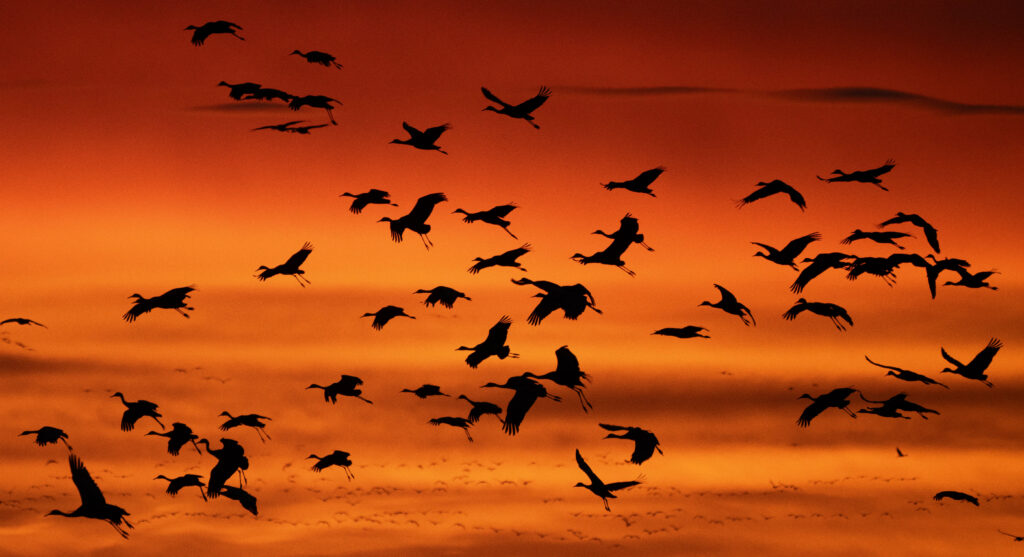
Sandhill Cranes swirl in the skies during the annual migration through Nebraska. Pam LeBlanc photo
I’m perched on a stool in a bus-sized blind along the Platte River, my eyes trained on the sky, which looks like it’s on fire as the sun sets.
I’ve come for the annual Sandhill Crane migration, when hundreds of thousands of raucous, ivory-colored birds pass through south-central Nebraska during their migration from Texas and Mexico to northern Canada and Siberia. It’s the largest gathering of cranes anywhere on the planet, and right now, roughly half a million birds are roosting on this 80-mile stretch of river.
The show starts slowly. A few waves of a dozen or so birds, each 3- to 4-feet tall with a 5- to 6-foot wingspan and a red patch on its head, circle overhead, bellowing their arrival. Over the next two hours, more and more birds arrive, until the sky is swirling with flapping wings. The cacophony grows as the birds drop to the shallow river, finding their place along the riverbed.
One of nature’s greatest performances
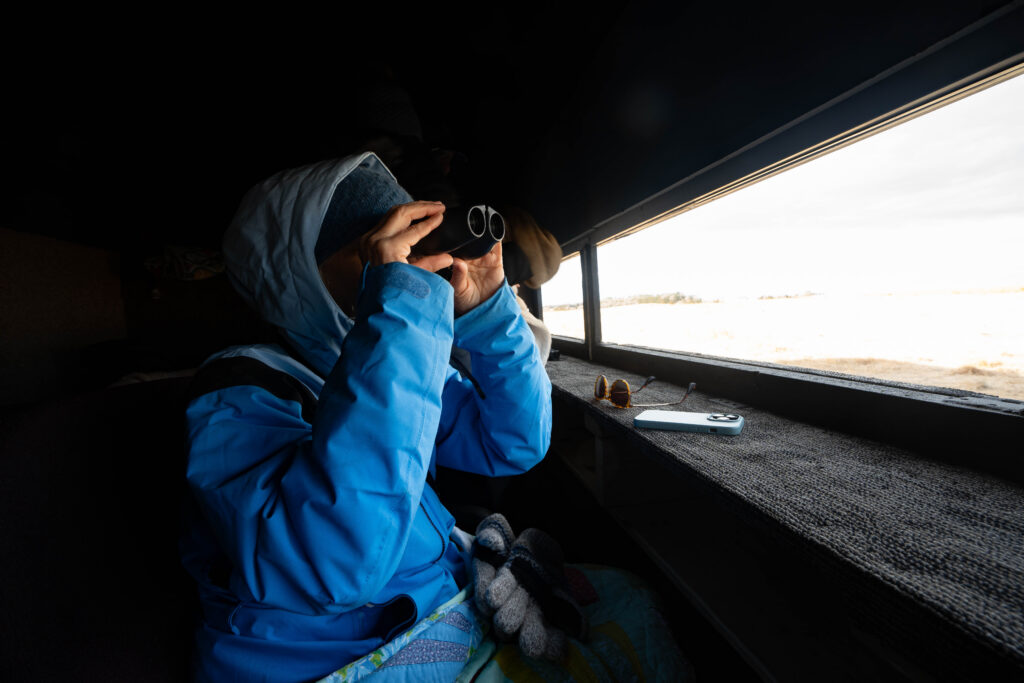
A birder watches Sandhill Cranes come in to roost along the Platte River in Nebraska. Pam LeBlanc photo
I’ve watched brown bears fish for salmon at Katmai National Park, swum with humpback whales at the Silver Bank north of the Dominican Republic and seen thousands of penguins waddle up an ice-covered slope in Antarctica. This performance is every bit as compelling. I’m mesmerized by the way the birds drop their stick-like legs like landing gears, then drift to the ground like a flock of Mary Poppins riding umbrellas.
The visit to Rowe Sanctuary was the highlight of a bird-focused week in Nebraska that included six early morning and evening birding excursions to see cranes and prairie chickens. In between, we visited museums, galleries and kitschy tourist attractions.
“You are here to experience North America’s great migration,” Marcus Stoltfus, executive director of the 3,000-acre Rowe Sanctuary, said when we arrived at the sanctuary’s Iain Nicolson Audubon Center. “This is the spot on the Platte River that 80 percent of the crane population comes.”
In all, an estimated 1.2 million cranes migrate through Central Nebraska each year. They stop along the Platte for three to four weeks, resting before resuming their migration north. While they’re here, they bulk up on corn, vertebrates and insects by day, packing on 2 to 4 pounds. At night they roost in ankle-deep water on the braided Platte River.
“It’s hard to describe,” Marcos says. “Where else can you see tens of thousands of birds on a river? They call and dance and jump and fight. It’s unlike what most people think of when they think of bird watching. I hope people come away with sense of awe and interest in protecting that.”
Sandhill Crane migration brings tourism dollars to Nebraska
Crane tourism brings in big bucks, too, and that amount is growing. According to an economic impact study from the University of Nebraska, visitors traveling to the area to see the birds spent $14 million in 2017. That amount increased to $28 million in 2025.
“It’s our version of March Madness,” says Brad Mellema, who spent one evening driving me and a few others through the farmland outside Grand Isle.
We unroll the windows and listen. You can hear Sandhill Cranes up to 2 miles away. It sounds like the distant din of a football stadium – one that’s overflowing with fans.
Read more: In the French Alps, Luxurious Eleven Chalet Hibou Caters to Adventure Seekers
“I’m convinced that’s what a dinosaur sounded like,” Mellema says.
Sandhill Cranes live from 7 to 15 years in the wild. In Texas and other states, it’s legal to hunt them. (Google the term “ribeye of the sky” and you’ll get a flood of hits.) Here, though, they are protected.
Key places to watch Sandhill Cranes in Nebraska
Early one morning we make our way to the Crane Trust, where we’re led in the pre-dawn quiet to a series of heated blinds along the Platte River. It’s cold, just 12 degrees, and thousands of birds are huddled shoulder to shoulder on the partially frozen river. Sometimes, ice forms around their legs overnight. In the morning, “ice bracelets” cling to their ankles as they wake up and start moving. We wait, hoping they’ll take off as a group, but apparently the blustery weather has convinced them to sleep in this morning.
We head back to a gathering room at the site for breakfast. Visitors can book a room in onsite cabins, and attend lectures and birdwatching “safaris,” but space fills early. The cranes are stars.
Another night, we bundle up for a more rustic crane-watching experience. Instead of blinds, we head to a finger of tree-fringed land along the river. Here, at the Crane Cabin Retreat, we set up folding chairs for a river’s edge tour on property owned by farmer Chad Gideon. He supplements the income he makes farming corn, soybeans and sod by hosting bird watchers.
“I didn’t realize it would take off as fast as it did,” Gideon says.
Tonight, a dozen tourists have popped open chairs and wrapped themselves in blankets for the show.
“I’ve always been interested in wildlife and watched shows about this, and I said, ‘Let’s go,’” says Jody Senini of Billings. “It’s everything I thought it would be, and you never know with nature.”
As we pack up to go, we pause. The birds are still trilling, just as they’ve done for thousands of years. It’s so loud I can feel the vibration in my chest. “That’s the sound of ancient Nebraska,” Mellema says.
On to the chickens
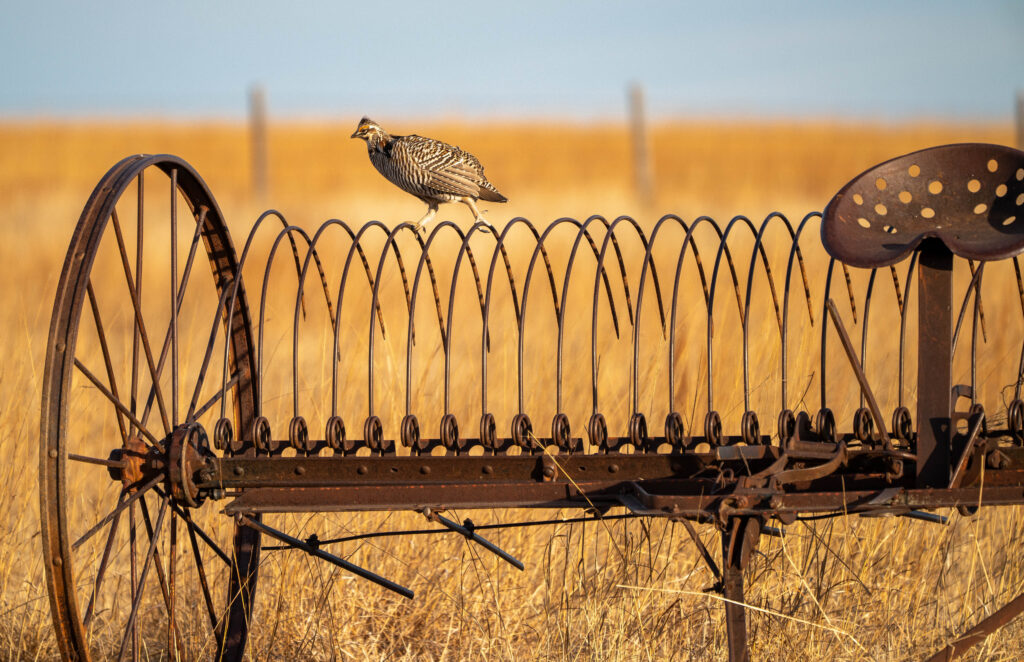
A prairie chicken struts along a piece of farm equipment in Nebraska. Pam LeBlanc photo
Crane migration coincides with prairie chicken booming season, and we arranged two mornings to watch the chunky birds strut their stuff.
Reading more: No Crowds but Plenty of History on the Dutch Island of Sint Eustatius
Prairie chickens don’t migrate, but each spring, the birds gather on a “lek,” an open, raised mound, in a courtship ritual called “booming.” The males inflate mango-sized pouches on the sides of their necks and make loud woo-woo noises as they dance, jump and spar with other males. It’s all to impress the females, which, at least during our visit, looked rather underwhelmed.
Beyond the birds
This trip to Nebraska isn’t all about birds.
Because most of the birding happens early in the morning or at dusk, we had plenty of time to explore during the day.
If you plan a trip, start in Grand Isle. At the Stuhr Museum, learn about the early German settlers who came to the state and stroll through a village of more than 100 buildings that date to the 1980s.
Then head to Kearney. Classic car fanatics will love peeking under the hood (and in the windows) of 170 vintage vehicles at the American Automobile Experience. (Don’t miss the supercharged Shelby Mustang GT350, with an autographed dash). At the Museum of Nebraska Art, or MONA, admire 5,000 works of art by Nebraska artists, and a ceiling that will remind you of cranes flapping overhead. Walk through an immersive exhibit representing 180 years of history on the Mormon, Oregon, Pony Express and California trails at The Archway over Interstate 80.
North Platte is worth a stop, too. Take in the view of the largest classification railyard in the world, which processes 12,000 railroad cars every day, at the Golden Spike Tower in North Platte. The Prairie Arts Center in the Canteen District is housed in a former post office built in 1913. Stop by the Fort Cody Trading Post to see Buffalo Bill’s Miniature Wild West Show, where thousands of moving characters come to life in a free performance every half hour. The Lincoln County Historical Museum features an excellent exhibit about the North Platte Canteen, which fed 6 million members of the U.S. military who passed through by train during World War II. Wrap up your visit with a stroll through the grounds of the country’s most famous Wild West showman at Buffalo Bill Ranch State Historical Park.
If You Go

Getting there:

Stay:

Do:

Eat & Drink: