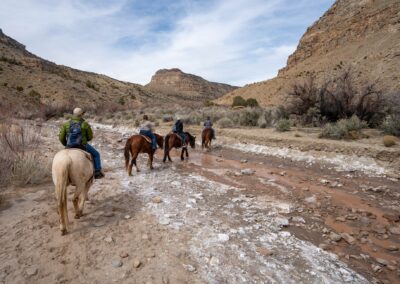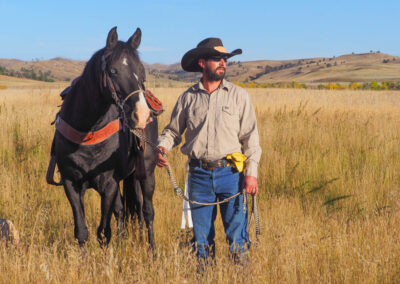



George Kimball leads a train of pack mules along the John Muir Trail near Donahue Pass. Pam LeBlanc photo
A decade ago, my husband and I walked 200 miles along the John Muir Trail, which traces the spine of the Sierra Nevada Mountains from Yosemite National Park to Mount Whitney in California. We lugged heavy backpacks through forests and over eight rocky mountain passes, ate dehydrated meals for 15 days, and collapsed, exhausted, into our tent each night.
Backpacking is my bliss. It connects me to nature and gives me access to some of the most beautiful places in the world. But as I’ve gotten older, my back has gotten creakier. This year, I wasn’t sure I could still carry a fully loaded backpack over long distances.
It turns out I didn’t have to.
I joined Wildland Trekking for a much shorter, mule-supported backpacking trip on the trail in August. A team of five mules carried camping gear and food for our group. All I had to do was load water, snacks, a rain jacket and my camera into a daypack and jet off up the trail.
Read more: In Nebraska, Sandhill Crane migration draws flocks of birdwatchers
Getting ready
I’m used to hiking with people I know well. I wasn’t sure how a group trip would work. What if we all walked at different speeds? Would we have to stick together?
After an early morning meetup in Fresno, we drove four and a half hours to a campground near June Lake, just outside of Yosemite National Park. Our group of seven (plus two guides) ranged in age from our 30s to our 70s, and included an emergency room surgeon, an environmental lawyer, and a retired engineer. Besides me, two others had hiked the trail before – one as a young man 34 years earlier.
Our guides handed out tents, packs, hiking poles, sleeping bags and pads, and that evening, we got an overview of our adventure. We’d be covering about 30 miles during four days of hiking. The toughest stretch would come the first day, when we would climb nearly 3,000 feet over about 6 miles.
Oh, and we’d have to dig catholes when we needed to poop.
Hitting the trail
We started early. After an introduction to the five barrel-chested mules that would ease our burden, and the driver who would lead them, we left the Frontier Pack Train station and started our climb up Rush Creek.
Less than an hour in, the mules clattered past. They’d arrive at camp long before we would.
Our group split quickly, with one guide leading the faster hikers and a second guide sticking with the others. My natural pace kept me toward the front, where guide Fred Ackerman briefed me on the history, flora and geologic features of the area.
Construction of the John Muir Trail, named after the Scottish born naturalist and writer John Muir, began in 1915. Muir helped spur the preservation of Yosemite Valley and was known as “The Father of the National Parks.” He roamed these mountains for days at a time, often packing just bread crusts and water to sustain him during his ramblings.
It got hot as we hiked, and I stopped to dunk my shirt in the creek as we marched up a ravine, past bunches of purple and yellow wildflowers. By the time we reached our campsite at Clark Lakes, I needed to cool off.
I popped up my tent, peeled off my clothes, and cooled off in the mountain-rimmed lake. I didn’t feel exhausted, I felt energized. And the guides made grilled salmon for dinner.
Read more: In the French Alps, luxurious Eleven Chalet Hibou caters to adventure seekers
A respite

Thousand Island Lake gleams in the sun. Pam LeBlanc photo
While Day One served up a long, steep climb, Day Two offered a gentler profile.
After watching the mules guzzle water at the lake at sunrise, we hit the trail. A few hours later we reached Thousand Island Lake, where we officially joined the John Muir Trail.
This trip, for me, was all about stopping to swim and drinking in the scenery. We flopped onto boulders and soaked up the sun along the lake’s edge, chatted with other hikers, and dove into the blue-green water. From there we aimed for Island Pass, where we stopped for lunch (and another swim) at a small lake.
But our focus for the day was a short spur trail to Marie Lakes, where, our guides assured us, we’d find one of the best campsites on the planet.
They weren’t wrong. We pitched our tents among boulders in a sub-alpine setting that looked like the backdrop of a Star Trek episode. Just below us, a creek spilled over a rocky lip, forming a waterfall into the world’s most perfect swimming hole.
We had hours to enjoy it.
Going a little wild

Fred Ackerman looks toward Tuolumne Valley from the top of Donahue Pass on the John Muir Trail. Pam LeBlanc photo
Instead of hiking a mile back down to the official trail and then climbing up to Donahue Pass the next morning, we decided to go rogue. From our campsite, we scampered off-trail for an hour and a half, spreading out to reduce our impact and clambering over boulders. (It’s allowed.)
At the top of a ridge, we admired thumb-sized tadpoles swimming in a small pond and clusters of lupines that reminded me of Texas bluebonnets.
The view was magnificent, a vast bowl of cracked rock and a few fat marmots. We scooted around the side of the slope, eventually re-connecting with the official John Muir Trail. Donahue Pass looked daunting, but early trail builders built blocky stairs to smooth the route.
At the summit, we officially crossed from the Ansel Adams Wilderness into Yosemite National Park. A pair of blue lakes glinted far below.
Not far from the Lyell Fork of the Tuolumne River that night, we gathered around a campfire, eating a backcountry version of bananas foster and talking about the highlights of this trip.
For me, nothing compares to a night in a million-star hotel.
That left nothing but a 9-mile stroll over mostly flat, forested ground –– a valley to our finish at Tuolumne Meadows in Yosemite National Park the next day.
Strolling alongside the river, I thought about Muir and his impact here. I pictured him herding sheep in the high country, getting to know every wrinkle and rock outcropping of this wilderness. Looking up at the tall trees, I remembered how he once lashed himself to the top of a 100-foot spruce during a windstorm, then wrote about the experience. And listening to the river chatter, I thought about his opposition to a dam that was eventually built in nearby Hetch Hetchy Valley. That defeat sparked the conservation movement in America and led to the creation of the National Park Service.
As I unclipped my daypack and sat down on a log, I thought about what parks mean to me. The wilderness is where I feel most human. It’s where I go to recharge and remind myself what’s important. Real life happens out here, not indoors, in a city built of cement and asphalt.
I’m grateful to the mules for allowing me to keep coming out here.
If You Go

Getting there:
I flew from Austin to Fresno, California, where I stayed the night at a chain hotel and met the group from Wildland Trekking the next morning. We drove through Yosemite National Park on our way to June Lake.

Stay:
Once the hiking part of the trip began, we camped for four nights – one night in a developed campground and three nights in the backcountry. I booked another night in a hotel in Fresno and caught a flight home the following morning.

Do:
Hike! You’ll only need a daypack as you cover 6 to 10 miles each day. You should be reasonably fit.

Food & Drink
Wildland Trekking provides all food. Guides cook hot meals each night and a hot breakfast most mornings. Lunch is a spread of meats, cheeses and crackers. Snacks are provided too.

Pro Tip:
Pack a pair of gaiters (mine are made by Dirty Girl) to keep dust and rocks out of your shoes.